Sanibel Rice Rat: A Species Found Nowhere Else—and Why Its Habitat Is Shrinking
Last Updated: March 25, 2026
Sanibel Rice Rat: A Species Found Nowhere Else—and Why Its Habitat Is Shrinking
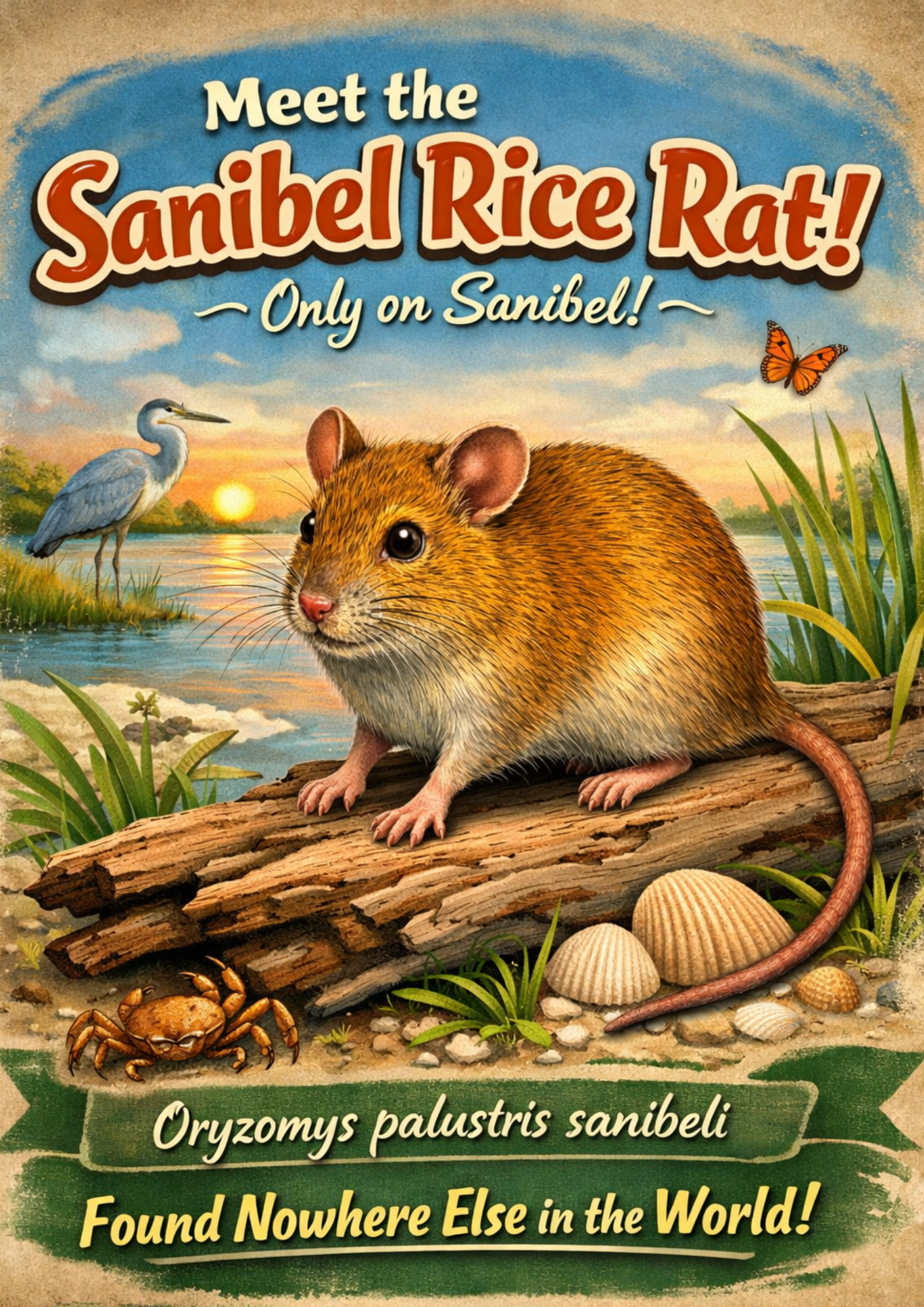
On an island known for shells, beaches, and wildlife, one of Sanibel’s most important residents is something most people will never see. The Sanibel rice rat lives quietly in the island’s coastal marshes, far from homes and foot traffic, yet its future is tied directly to how Sanibel grows, develops, and protects its natural spaces. With a habitat measured in narrow strips and a population that’s still largely unknown, this small, elusive animal tells a much bigger story about the fragility—and value—of Sanibel’s environment.
Where It Lives (And Where It Doesn’t)
Despite the name, this is not a rat you’ll ever find in your home or around businesses.
The Sanibel rice rat avoids people, avoids buildings, and stays deep within tidal marshes, mangrove edges, and coastal wetlands. These are quiet, undisturbed environments that most residents and visitors never enter.
That distinction matters. This is not a nuisance animal—it’s a highly specialized native species that depends entirely on natural coastal systems to survive.
A Habitat Measured in Narrow Strips
Sanibel may feel like a spacious island, but the rice rat’s world is incredibly small.
It depends on very specific environmental conditions—subtle differences in elevation, water flow, and vegetation. Because of that, its habitat exists in thin, fragmented bands around the island rather than large, continuous areas.
While Sanibel stretches roughly 12 miles long, only a small fraction of that land actually supports this species. And because it exists only here on Sanibel Island, there is no opportunity to relocate or expand beyond these limited zones.
What We Don’t Know (And Why That Matters)
One of the biggest challenges in protecting the Sanibel rice rat is how little data exists.
Research efforts led by the Sanibel-Captiva Conservation Foundation have included trapping and monitoring, but only a very small number of these animals have ever been captured and studied.
That means:
The population size is still uncertain
The full range across the island isn’t completely mapped
Long-term trends are difficult to measure
For a species this limited, that uncertainty makes proactive conservation even more important.
How to Pronounce Its Scientific Name
The scientific name for the Sanibel rice rat is Oryzomys palustris sanibeli.
Pronounced:
oh-RYE-zoe-miss pal-US-triss san-ih-BELL-ee
Why Buttonwood Can Become a Problem
Protecting habitat on Sanibel isn’t just about preserving land—it’s about maintaining ecological balance.
According to ongoing work by the Sanibel-Captiva Conservation Foundation, one of the biggest challenges in coastal systems is when a single plant species begins to dominate. On Sanibel, a key example is Buttonwood.
Buttonwood is native, but in certain conditions it can spread aggressively, forming dense, woody thickets that take over open marsh areas.
When that happens, several important changes occur:
Plant diversity declines as Buttonwood shades out lower-growing marsh species
The habitat becomes more uniform and less functional
Ground-level movement and cover for small wildlife becomes more restricted
For the Sanibel rice rat, this directly impacts its ability to move, forage, and stay protected within the marsh.
The effects extend beyond mammals.
Wading birds like the great egret and great blue heron rely on open, shallow-water feeding areas. As Buttonwood encroaches:
Open hunting areas are reduced
Visibility needed to spot prey is limited
Water flow and prey distribution can be altered
In short, dense Buttonwood doesn’t just change how the habitat looks—it changes how the entire ecosystem functions.
That’s why SCCF actively manages these areas, selectively thinning or removing Buttonwood where it begins to dominate. The goal is not removal—but balance, allowing a diverse mix of native plants to thrive.
Fragile Systems Require Active Stewardship
Coastal ecosystems like those on Sanibel are dynamic and easily tipped out of balance.
Without intervention, dominant species can reshape habitats over time. Combined with pressures like storms and sea level rise, those changes can accelerate quickly.
The work being done by the Sanibel-Captiva Conservation Foundation ensures these environments remain diverse, functional, and capable of supporting species like the Sanibel rice rat.
Why Its Habitat Is Still Shrinking
Even with thoughtful management, the total amount of usable habitat continues to face pressure.
Storm surge can wipe out vegetation overnight, while sea level rise gradually compresses marsh areas between open water and developed land. Over time, this “coastal squeeze” leaves less room for these ecosystems to exist.
For a species confined to narrow environmental bands, even small losses matter.
Why Saving This Species Matters—Now
The Sanibel rice rat is more than just rare—it’s a reflection of the island’s ecological health.
Because it depends on such specific conditions, its presence signals that the surrounding habitat is functioning properly. When species like this begin to decline, it often points to broader environmental changes.
And because it exists only on Sanibel, its loss would be permanent.
There is no second population. No relocation option. No way to bring it back.
Protecting it now—through conservation, habitat management, and continued research—is far more achievable than trying to recover it later.
What This Means for Sanibel Real Estate
Sanibel’s long-term value has always been tied to its balance between development and conservation.
Efforts led by the Sanibel-Captiva Conservation Foundation don’t just protect wildlife—they help preserve the character of the island itself. Protected wetlands, managed habitats, and limited overdevelopment all contribute to what makes Sanibel different from other coastal markets.
This level of conservation plays a direct role in protecting property values over time, ensuring the island remains defined by its natural beauty rather than overbuilding.
In many ways, protecting species like the Sanibel rice rat is part of protecting the future of Sanibel real estate.
The Takeaway
The Sanibel rice rat lives quietly in marshes most people will never see—but its future depends on decisions being made right now.
Its habitat is limited.
Its population is still not fully understood.
And its ecosystem requires active management to remain balanced.
Thanks to the work of the Sanibel-Captiva Conservation Foundation—including efforts to manage species like Buttonwood—there is still an opportunity to protect this one-of-a-kind animal.
Because once it’s gone, it’s not just rare—
it’s gone forever.
Main Photo Credit: FWC Fish and Wildlife Research Institute